Last week’s blog post

So, I have a confession to make. I’ve been watching the development of generative AI over the course of the last few months with interest, but haven’t really experimented with it much until quite recently. And that includes… the blog post I published last week. I used ChatGPT to produce it because I was keen to (a) see what it was capable of and (b) see whether something co-produced could generate genuine and thoughtful discussion. (I’ll get to my definition for “co-produce” in a minute.) I now have answers to both those questions, but first, let me tell you the story of how the post came about.

(Oh, by the way – this blog post was not written with the help of any AI. Sorry to interject, but I knew some of you would be wondering. Back to the story.)

Earlier this year I was in a conversation with some preservice teachers. One of them asked me a question and I gave him an answer on the spot, but as I reflected on that conversation later that day, I realised that I had never really articulated a full answer to this particular question up until this day. So I hastily jotted down the outline of the answer I gave, so that I wouldn’t forget the key points, and thought to myself that I might revisit these notes and turn them into something a bit more systematic. Here is that page of notes. Yes, I know it’s messy (I told you it was hasty!):
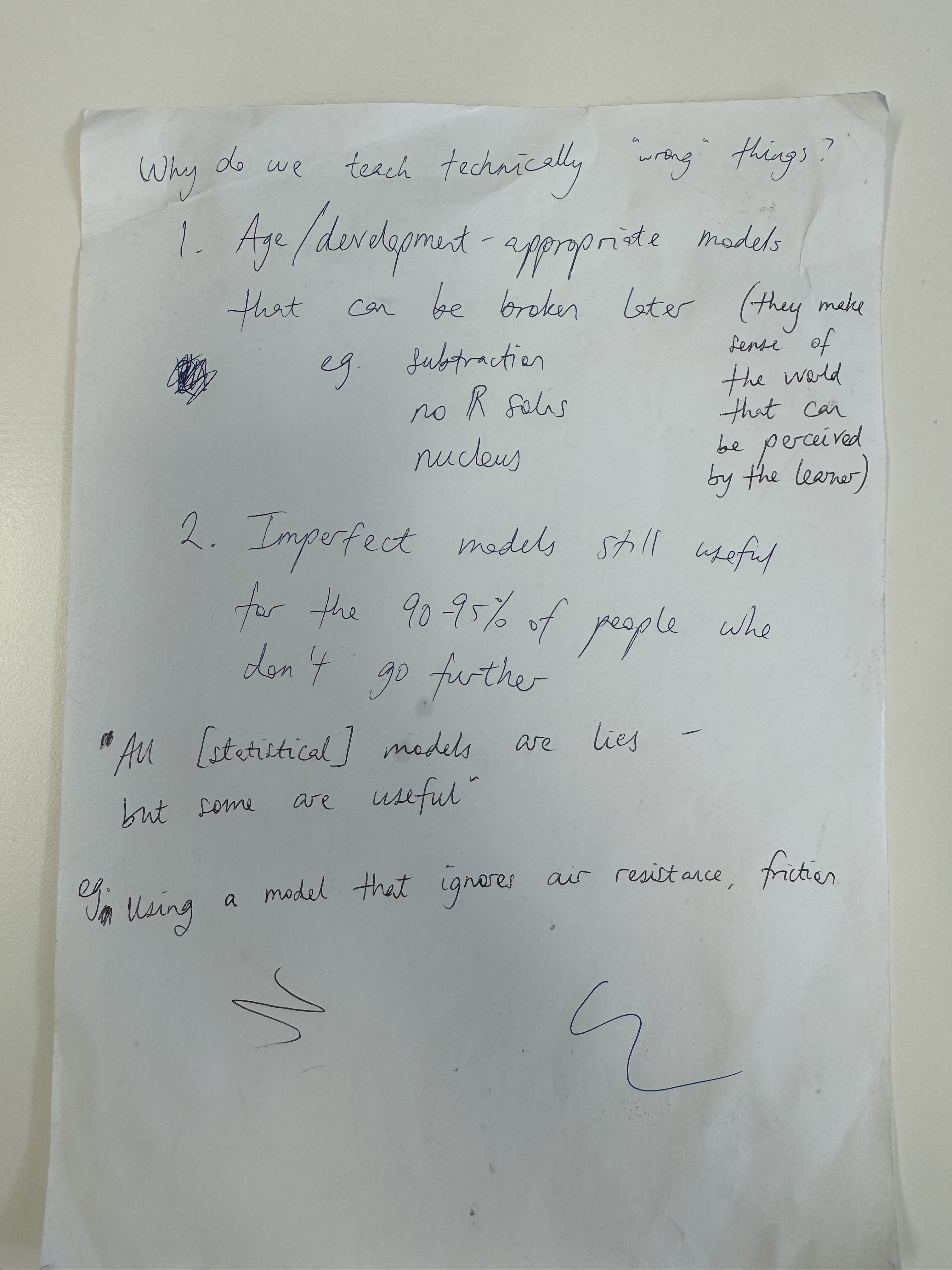
Some time later I read about how OpenAI had updated ChatGPT with some visual recognition models. I wondered, “Could ChatGPT read this and make sense of it? Could it do more than make sense of it – could it expand on the thoughts that I’d written down?” If you read the blog post linked above and make a comparison, you’ll see it did a pretty decent job (and even accurately identified the source of the quote, which I couldn’t remember when I jotted this down).

There’s still much to explore and question, but this small experiment has definitely given me some early answers to the questions I posed before. What is ChatGPT capable of? A coherently written post that successfully expands on my basic ideas, at the very least. That said, I did find its writing style to be quite stilted. In particular, the sentence construction and cadence were remarkably consistent all the way through. It reminded me of this:
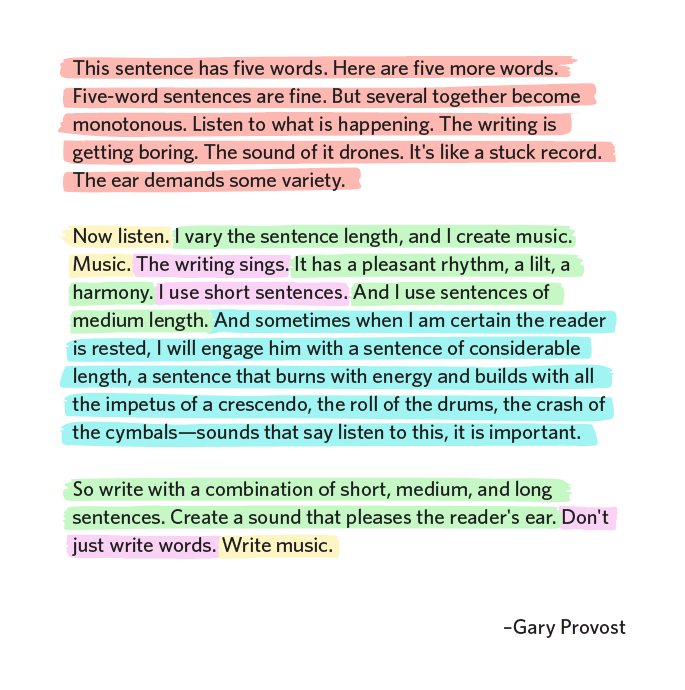
ChatGPT defaults to write more like the first paragraph than the second and third. This plain style is a known phenomenon, and many have written about it. I acknowledge that it can be coached to write in different ways but I did want to see where it naturally landed – and since I imagine that I will use ChatGPT in the future to save myself time, I wanted to see what it was capable of doing without copious amounts of effort from me. I actually enjoy the process of writing and editing, so if I was going to invest significant time into writing something (like this post), then I would rather spend that doing the writing myself rather than wrestling with the LLM to get it to do the work for me. But this is noteworthy nonetheless. And this is where I come to my definition for “co-produce”, which is a phrase I’m adopting because I don’t feel comfortable saying that I wrote the original blog post. (And based on my knowledge of how large language models work, I don’t even know if I would call what ChatGPT does “writing” either!) However, I didn’t ask the AI to brainstorm for me; I provided it a very concrete direction and asked it to expand on what I presented to it. If you’ll permit me to anthropomorphise briefly, we were partners in the process – hence “co-produce”.

My other question was around what kind of discussion this would prompt. Answer: plenty. I’m posting these particular comments because they were posted publicly; I received even more responses in other private contexts where I shared the same post.
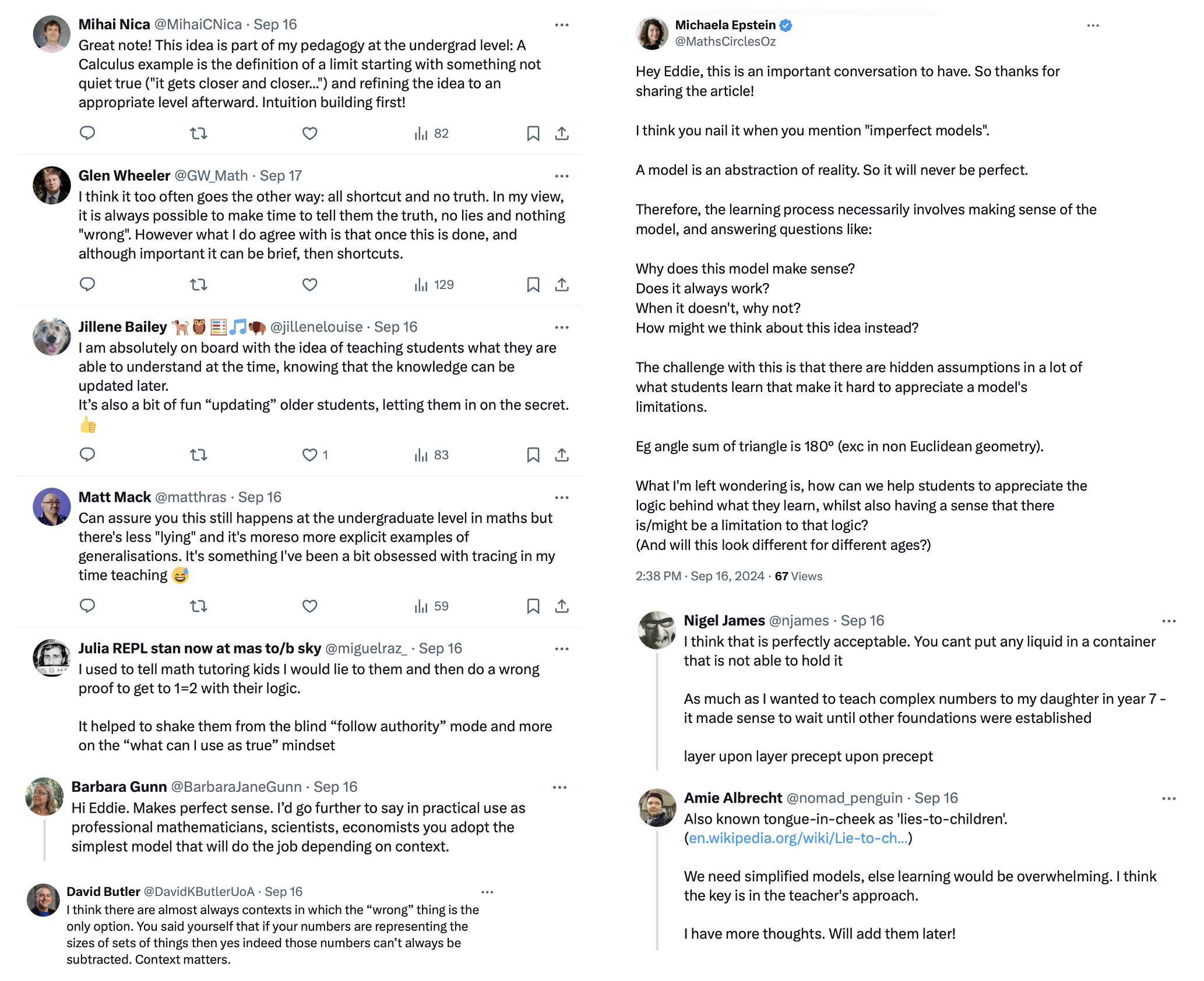
I do wonder if there would have been as much discussion if people had known from the outset that I’d used AI to put this together. Maybe if you were one of the people who responded in the first place, and you’re also reading this reflection of mine, you can throw your thoughts into the ring one more time for me.

Now, just so you know that I don’t think AI is going to replace us any time soon, let me share with you the next chapter of the story. I was at a PL session recently where we were presented with a very classic word problem, the kind that I would instinctively solve by introducing some algebra. But I wanted to try and see if I could explain it to the 9-year-old boy sitting next to me without appealing to algebraic techniques, so I drew this:

I asked ChatGPT, “Can you create accurate diagrams based on an image of hand-drawn text and diagrams?” And with its characteristic confidence, it replied: “Yes, I can help create accurate digital diagrams based on an image of hand-drawn text and diagrams. If you upload the image, I can analyze it and either recreate or enhance the diagrams digitally for clarity and precision. Let me know if you’d like to proceed with that!”

I did want to proceed with that. And here is what ChatGPT handed me:
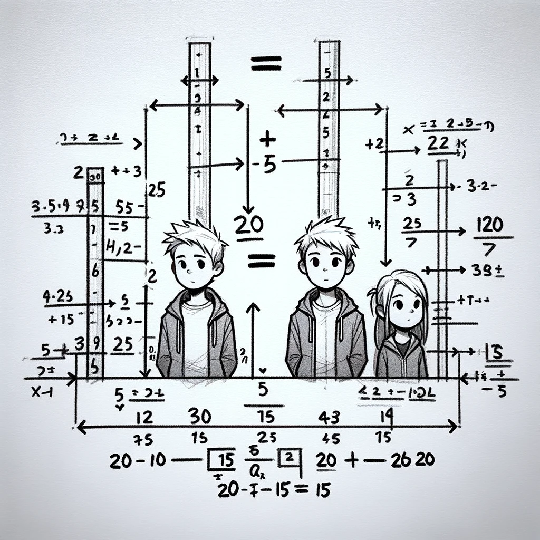
OpenAI still has a ways to go yet! But it seems clear to me that we are still at the very beginning of learning how AI will change what education looks like.

Why Do We Teach Technically “Wrong” Things?

When teaching students, especially in the early stages of their education, it’s common to simplify complex ideas or teach models that are, in some ways, technically “wrong.” (In mathematics, we might say that something isn’t “rigorous”.) This may seem counterintuitive at first—after all, shouldn’t we strive to teach the “truth” from the start? However, I think there are compelling reasons why educators rely on imperfect models and simplified concepts in their teaching.

models that are fit for purpose

One key reason is the need for developmentally appropriate models. These simplified versions of complex concepts are easier for students to grasp, especially when they are still developing their cognitive skills. While these models may not be entirely accurate, they provide a foundation that can be revised (or “broken”) later as the student advances and is ready to tackle more nuanced understandings of the world.

Examples of Simplified Models:

  • Subtraction: for younger students, subtraction is about “taking away” – we start with a number of concrete objects and then we remove some of them, then ask students how many remain. It’s a bit nonsensical in that context to talk about removing 5 objects when you only have 3 to begin with, so subtraction is initially taught without introducing negative numbers. The idea that you “can’t subtract a larger number from a smaller one” is later revised when students learn about negative numbers and broader number systems.
  • The Atomic Nucleus: in science, the atom is often depicted as a simple nucleus with electrons orbiting it, much like planets around the sun. This model is later revised to incorporate quantum mechanics and the probabilistic nature of each electron’s behaviour.

These models may be technically incorrect, but they serve as an essential bridge to more accurate scientific and mathematical understanding. As students mature, they can refine and update their mental models to accommodate more sophisticated ideas.

Imperfect Models Are Still Useful

For the vast majority of learners—those who won’t specialise in advanced scientific or mathematical fields—these simplified models may be all they need to navigate everyday life. I feel as though 90-95% of students won’t pursue careers that require a deep understanding of these subjects, so teaching them perfectly accurate models from the start may not always be practical.

The quote from George Box, “All models are wrong, but some are useful,” encapsulates this idea well. Box was highlighting that even though models are simplifications of reality, they can still provide valuable insights and serve practical purposes. For most people, an imperfect model offers enough accuracy and intuition to make sense of the world and solve everyday problems. Here are some well-known examples of imperfect but nonetheless useful models:

  • Newtonian Physics: High school students often learn about the laws of motion and gravity using Newton’s equations. While these are technically inaccurate at relativistic speeds or quantum scales, they work fine for most real-world applications, such as predicting the motion of everyday objects.
  • Resistive Fluids: In many physics problems, students are asked to ignore air resistance or friction when calculating motion. For instance, when calculating the trajectory of a projectile, the effect of air resistance is often omitted, even though it’s crucial in real-world scenarios like baseball or car racing.
  • Ideal Gas Law: The equation PV = nRT is a simplified model of how gases behave. It ignores interactions between gas molecules, but it provides a useful approximation for most common situations, like understanding the behaviour of air in a balloon.
  • Linear Equations in Economics: In economics, linear models are used to predict relationships between variables, even though real-world systems are often far more complex. These models are useful for basic predictions and decision-making but don’t capture the full complexity of economic interactions.

By ignoring complicating factors, students can focus on mastering the basic principles (very helpful from a cognitive load theory point of view). As their understanding deepens, they can gradually reintroduce these elements to form a more complete picture of the phenomena being studied.


Conclusion: The Role of Simplified Models in Education

While teaching “imperfect” models might seem counterproductive at first, these simplified frameworks play a crucial role in education. They provide an initial foundation on which students can build a more accurate understanding of the world. For most people, these models are useful and practical, enabling them to make sense of the world in an accessible and manageable way.

As students grow and learn, these simplified models are revisited, challenged, and refined, just as scientific theories themselves evolve. In the end, these early approximations help make complex ideas approachable while still providing enough accuracy to be useful for most practical applications.

Lesson Videos

I upload videos of my classroom mathematics lessons to my YouTube channel. If you’d like to use them to help you learn, search for the relevant topic below within the section that relates to you:

A few other points for you to be aware of:

  • These topics are aligned to the NSW Mathematics curriculum. If you live in another Australian state or territory, please use the Mathspace + Wootube portal.
  • Some topics below have “related content” – this includes videos that explain connected skills and concepts, but may not be within the scope of the syllabus.
  • In some lessons, I teach multiple topics so they don’t fit neatly into a heading below. You can find those videos in Mixed Topics.
  • As part of enrichment classes, I’ve taught several concepts that aren’t related directly to the syllabus. You can find those in Mathematical Exploration.

Stage 4 Mathematics (Years 7 & 8)

Number & Algebra
Topic This playlist includes…
Computation with Integers Ordering & calculating with whole numbers
Fractions, Decimals and Percentages Operating & converting between number forms
Basic Financial Mathematics Purchasing goods
Basic Ratios & Rates Operations and graphical representation
Basic Algebraic Techniques Introduction to algebra & pronumerals
Basic Indices Operations with positive integer & zero indices
Basic Equations Solving simple equations
Basic Linear Relationships Number patterns & straight line graphs
Measurement & Geometry
Topic This playlist includes…
Measuring Basic Shapes Length, area & volume
Time Units of time & time zones
Pythagoras’ Theorem Calculating side lengths
Basic Properties of Geometrical Figures Classify shapes; congruent triangles
Angle Relationships Angle properties, parallel lines (and related content)
Statistics & Probability
Topic This playlist includes…
Data Collection & Representation Surveys, graphs & charts
Basic Single Variable Analysis Measures of location & range
Basic Probability Chance of simple & compound events


Stage 5 Mathematics (Years 9 & 10)

Number & Algebra
Topic This playlist includes…
Further Financial Mathematics Earning, Spending & Investing
Further Ratios and Rates Proportion problems & working with graphs
Further Algebraic Techniques Algebraic fractions & quadratic expressions
Further Indices Operations with negative & fractional indices
Further Equations Solving quadratic, cubic & simultaneous equations (and related content)
Further Linear Relationships Coordinate geometry techniques (and related content)
Non-Linear Relationships Sketching & interpreting curved graphs
Polynomials Sketching, factor & remainder theorem
Logarithms Define logarithms & use laws
Functions & Other Graphs Use function notation & sketch graphs
Measurement & Geometry
Topic This playlist includes…
Measuring Further Shapes Area, surface area & volume
Numbers of Any Magnitude Scientific notation & significant figures
Trigonometry Angles & sides in triangles
Further Properties of Geometrical Figures Similar figures, geometric reasoning (and related content)
Circle Geometry Deductive arguments with circle theorems
Statistics & Probability
Topic This playlist includes…
Further Single Variable Analysis Quartiles, box plots, standard deviation
Bivariate Analysis Relationships between two variables
Further Probability Multi-step experiments (and related content)


Mathematics Standard 2

Year 11
MS-A1 Formulae and Equations
MS-A2 Linear Relationships
MS-M1 Applications of Measurement (and related content)
MS-M2 Working with Time
MS-F1 Money Matters
MS-S1 Data Analysis (and related content)
MS-S2 Relative Frequency and Probability

Year 12
MS-A4 Types of Relationships
MS-M6 Non-right-angled Trigonometry
MS-M7 Working with Rates and Ratios
MS-F4 Investments and Loans
MS-F5 Annuities
MS-S4 Bivariate Data Analysis (no specific content, but see related content in MA-S2)
MS-S5 The Normal Distribution
MS-N2 Network Concepts
MS-N3 Critical Path Analysis

Mathematics Advanced

Year 11
MA-F1 Working with Functions (and related content)
MA-T1 Trigonometry and Measure of Angles
MA-T2 Trigonometric Functions and Identities (and related content)
MA-C1 Introduction to Differentiation
MA-E1 Logarithms and Exponentials (and related content)
MA-S1 Probability and Discrete Probability Distributions

Year 12
MA-F2 Graphing Techniques (and related content)
MA-T3 Trigonometric Functions and Graphs (and related content)
MA-C2 Differential Calculus (and related content)
MA-C3 Applications of Differentiation (and related content)
MA-C4 Integral Calculus (and related content)
MA-M1 Modelling Financial Situations (and related content)
MA-S2 Descriptive Statistics & Bivariate Data Analysis
MA-S3 Random Variables

Mathematics Extension 1

Year 11
ME-F1 Further Work with Functions (and related content)
ME-F2 Polynomials (and related content)
ME-T1 Inverse Trigonometric Functions (and related content)
ME-T2 Further Trigonometric Identities (and related content)
ME-C1 Rates of Change
ME-A1 Working with Combinatorics

Year 12
ME-P1 Introduction to Proof by Mathematical Induction
ME-V1 Introduction to Vectors (comprehensive lessons by Miriam Lees)
ME-T3 Trigonometric Equations
ME-C2 Further Calculus Skills
ME-C3 Applications of Calculus (and related content)
ME-S1 The Binomial Distribution

Mathematics Extension 2

Year 12
MEX-P1 The Nature of Proof
MEX-P2 Further Proof by Mathematical Induction
MEX-V1 Further Work with Vectors
MEX-N1 Introduction to Complex Numbers
MEX-N2 Using Complex Numbers
MEX-C1 Further Integration (and related content)
MEX-M1 Applications of Calculus to Mechanics (and related content)

Books + TV

I’m the host of a children’s TV show called Teenage Boss, broadcast in Australia by the ABC. It’s currently available to stream on ABC iView.

I also co-hosted Ultimate Classroom, a STEM show broadcast in Australia by Channel 10. As part of this series, I teach contestants about the concepts and theories underneath the challenges they have to complete – you can view the full lessons on my YouTube channel.

My most recent books are Time Out and Team Trouble, illustrated adventure mystery novels in the Whodunnit, Eddie Woo? series. Recommended for fiction readers aged 7+.

My first book, Woo’s Wonderful World of Maths, is published in Australia and New Zealand by Pan Macmillan. It was also released in North America as It’s A Numberful World, published by The Experiment.

I have two children’s activity books, Eddie Woo’s Magical Maths and Eddie Woo’s Magical Maths 2. Each is full of fun and creative explorations of the mathematical stories in Woo’s Wonderful World of Maths. They’re designed especially for children ages 7-12.

A short biography was written about me by Rebecca Lim. It is part of the Aussie STEM Stars series published by Wild Dingo Press. It’s an illustrated paperback intended for young readers (10-13 years old), which tells the story of my childhood and how I became the educator that I am today.

Praise for Eddie’s writing

“Eddie Woo is one of the best math teachers on the planet. His book is as buoyant, open-hearted, and energetic as he is. Perfect for students, teachers, and parents alike, it’s a wonderful survey of the wonders of mathematics.” – Steven Strogatz, professor of mathematics, Cornell University, and author of Infinite Powers

“Not just a great teacher, Woo’s Wonderful World shows Eddie to be a storyteller too. Is there anything the Woo cannot do?” – Adam Spencer, Ambassador for Mathematics, University of Sydney

“Maths is just another “language” – and Eddie Woo makes it so easy and fun.” – Karl Kruszelnicki, Julius Sumner Miller Fellow, The University of Sydney

“A sweeping tour de force of how to engage people with mathematics.” – Matt Parker, author, comedian and maths communicator

“I never thought I’d read a maths book cover to cover, let alone sing its praises. Eddie Woo makes maths fun, accessible and relevant. Now we can all benefit from his extraordinary skill as a teacher.” – Jenny Brockie, journalist and TV host

“Eddie Woo’s gift is in using stories to help us see the way maths breathes life, colour, shape, and rhythm into the world around us. He’s transformed the lives of countless students in his classroom and on Wootube. Now he’s here to change how you see numbers too – whether you think you have a mathematical mind or not!” – Natasha Mitchell, science journalist and radio host

“Eddie Woo is an inspirational maths teacher. Why? Because he can also communicate, connect and write.” – Jane Caro, author

“Learning mathematics is like climbing the stairs of a skyscraper. It’s difficult and can seem utterly pointless. Some educators scream at us from a 10th story window as we look up at them in confusion. Eddie greets you at the foyer and is there beside you while you take each and every step. And once at the observation deck, he’s admiring the beautiful vista with you. Eddie is more than just the maths teacher we all wanted. Eddie is the maths teacher we all need.” – Simon Pampena, Australian Numeracy Ambassador, Numberphile Star

“For a mathematician, Eddie Woo is one helluva storyteller. An excellent and important read from beginning to end.” – Maxine McKew, Honorary Enterprise Professor University of Melbourne

“You probably know acclaimed math teacher Eddie Woo through watching his excellent videos on his WooTube channel. Well, now there is a book, and it’s a winner. A compendium of short essays where Mr. Woo shows how mathematics lies just beneath the surface in practically every aspect of our lives. What makes it sing is that his engaging personality shines through on every page, just as much as it does on video when he is in front of a class.” – Keith Devlin, Stanford university mathematician and author of many popular mathematics books

“Enthusiastic, energetic Eddie Woo explores mathematics in ways that reveal how human and beautiful it is.” – Nalini Joshi, mathematician, University of Sydney

About Eddie

I teach mathematics in Sydney, Australia. Since November 2012, I have uploaded videos of my actual classroom lessons to Youtube to share learning resources with the world. You can view a brief introduction to my channel, watch a lengthier (7 minute) presentation that explains some of my motivation for doing this, or hear a detailed (16 minute) explanation about the flipped classroom concept.

Main channel: youtube.com/misterwootube
Second channel: youtube.com/misterwootube2 (for teachers)
Twitter: twitter.com/misterwootube
Facebook: fb.com/misterwootube
Instagram: instagr.am/misterwootube
LinkedIn: linkedin.com/in/misterwootube

Roles
Classroom teacher, Cherrybrook Technology High School
Leader of Mathematics Growth, NSW Department of Education
Education Ambassador, University of Sydney / Faculty of Arts & Social Sciences
Author
Woo’s Wonderful World of Maths (It’s a Numberful World in the US)
Eddie Woo’s Magical Maths (children’s activity book series)
Whodunnit, Eddie Woo? (junior fiction book series)
Host, Teenage Boss and Ultimate Classroom
Advisory Board, UNSW Gonski Institute
Charity Ambassador, ausEE Inc.
TED speaker, (“Mathematics is the sense you never knew you had“, TEDxSydney)

Former roles
Board of Trustees, Museum of Applied Arts and Sciences
Member, Australian Multicultural Council
Fellow, Royal Society of New South Wales

Awards
2019 Western Sydney University Honorary Fellowship
2019 “40 Under 40” Most Influential Asian-Australian Awards
– Education category winner
2018 Australia’s Local Hero
National ceremony – 25 January 2018
Media scrum – 25 January 2018
ABC News Breakfast – 26 January 2018
Sunrise – 26 January 2018
TODAY Show – 26 January 2018
Sky News – 26 January 2018
Eddie and his Wootube channel win Australia Day recognition – ABC News
Wootube helps Sydney maths teacher scoop Australian Local Hero award – SBS News
The Australian teacher changing lives across the globe – 4BC Brisbane radio
Maths teacher Eddie Woo is Australia’s Local Hero – ABC Radio National
Cherrybrook Technology High School teacher wins Local Hero award – Hills News
Teaching needs a lift in status – Sydney Morning Herald
2018 Top 10 Global Teacher Prize
Announcement video – Varkey Foundation
Eddie Woo named ‘among world’s top 10 teachers’ – The Australian, 15 Feb 2018 (direct link, may lead to paywall)
Woo-hoo! Eddie could scoop $1.2m education prize – Daily Telegraph, 14 Feb 2018
Eddie Woo on reducing students’ maths anxiety – Teacher Magazine, 15 Feb 2018
Aussie Teacher Named As One Of The World’s Top 10 Educators – 2DayFM interview, 15 Feb 2018
Eddie Woo in Top 10 Teachers – Schools Plus
Global Teacher Prize 2018 Top 50 finalists announced – Teacher Magazine
Teachers in the running for Global Prize – The Educator
2018 Gold Harold
2017 Commonwealth Bank Teaching Fellowship
Videos woo students – Hills News
More Than Numbers – The Australian Education Reporter
2017 Sydney University Alumni Award: Outstanding Achievements for Young Alumni
2016 CHOOSEMATHS Teacher Excellence Award
Excellence award for Wootube master – Hills News
2015 Premier’s Prize for Innovation in Science and Mathematics Education in NSW

Television features
Channelling Mr. Woo – Australian Story 1 May 2017
Channelling Mr. Woo² – Australian Story refreshed episode 19 March 2018
ABC Q&A Education Special – October 2018
Advice To My Younger Self – November 2018
Eddie Woo changing the face of mathematics teaching – ABC News 1 May 2017
BBC World News – 22 March 2018
Studio 10 – 31 January 2018
The Drum – 22 January 2018
National Wrap – 25 February 2018
Jones & Co – 30 January 2018
SKY News – 20 January 2018
The AM Show (New Zealand) – 10 May 2017
Weekend Sunrise – 8 May 2017
“A Teacher Changed My Life” on SBS Insight (7 March 2017 – full episode available)
The 7:30 Report (9 December 2016 – transcript available)

News Coverage
2018 Australia Day Address (23 January 2018 – transcript available)
A lesson from Eddie Woo: Be a mathematician on Australia Day – Sydney Morning Herald
Why Eddie Woo used Australia Day to bring us all together – Daily Telegraph
ABC News on the 2018 Australia Day Address
Let educators get on with actual teaching – Opinion piece
Australia Day Address delivered by Youtube sensation – University of Sydney
Eddie Woo explains some of his favourites
Ranked 3rd Most Powerful Education Influencer in the Australian Financial Review (direct link, may lead to paywall)
Eddie Woo visits Warrnambool to share knowledge – Warrnambool Standard 21 May 2018
‘He Woo-ed us’: Rockstar maths teacher makes magic in Canberra schools – Canberra Times 14 May 2018
Kooringal High hosted Eddie Woo the ‘super’ maths teacher for a workshop with students – Daily Advertiser 8 Mar 2018
Eddie Woo scores roving role to teach the teachers how to inspire – Daily Telegraph 6 Mar 2018
YouTube maths sensation Eddie Woo wows crowd at James Fallon High School – Border Mail 9 Mar 2018
The teacher you wish you had: Woo wows audiences in Griffith – Area News 8 Mar 2018
Faith & Formulae: A Chat with Eddie Woo, Maths Teacher & Youtube Star (Hope 103.2 interview 5 Jun 2017)
Celebrity maths teacher on how to get smart kids into teaching – 2016 Profile in the Sydney Morning Herald
Wootube your way to better results in mathematics – Profile in The Australian (direct link, may lead to paywall)
Eddie Woo’s maths program Wootube proves a hit – 2015 Profile in the Sydney Morning Herald
Profile in the Berliner Morgenpost (web page is in German)
Profile in La Vanguardia (web page is in Spanish)
“What makes a good teacher?” Article featuring me in The Australian (direct link, may lead to paywall)
Sydney teacher Eddie Woo’s mathematics videos made him a viral sensation – Herald Sun Kids News

Publications
Woo’s Wonderful World of Maths – paperback published by Pan Macmillan
It’s a Numberful World – US edition of Woo’s Wonderful World of Maths, published by The Experiment
Eddie Woo’s Magical Maths – children’s activity book published by Pan Macmillan
Key To Human Flourishing – opinion editorial published by The Sydney Morning Herald
It Takes A School – opinion editorial published by The Guardian
A Design For Life – cover feature published by Times Educational Supplement
How To Help Your Child With Maths – article published by The Daily Telegraph

Audio
Don’t Fear Math – interview with Guy Raz for TED Radio Hour
Why Maths Matters – my interview of Steven Strogatz on What Keeps Me Awake for ABC Radio National
Radio interview 10 Oct 2016 – recorded live on 702 Mornings with Wendy Harmer
ABC Sydney: Drive radio interview 1 May 2017 – interviewed by Richard Glover
ABC Melbourne: Afternoons interview 1 May 2017 – interviewed by Clare Bowditch
2CC Canberra interview 4 May 2017 – interviewed by Tim Shaw
ABC Radio National – interview on Life Matters with Natasha Mitchell
What Works Best with Eddie WooCESE podcast
Interview with Corinne Campbell for the TER Podcast
Interview with Louka Parry and Maddy Scott-Jones for the Educhange Podcast
Interview with Monica Samayoa for 2SER 107.3FM
Interview with Robbie Buck for ABC Sydney: Breakfast
Interview with Ross Greenwood and Charlie Brown for Money News
Interview with Valerie Khoo for Sydney Lunar Festival
Interview with Shevonne Hunt for Kinderling Kids Radio
Interview with Ricardo Gutierrez for Innovator Diaries
Interview with Andy Dowling for the Andy Social Podcast
Interview with Ky Chow for On The Other Hand
Interview with Maxine McKew for Talking Teaching
Interview with Dave Jorna for Do Life Better
Interview with Andrew Leigh for The Good Life

Magazines & other press
Woo-hoo! Teaching kids to love maths – Curtin University
Maths is beautiful… wait, what? – Eternity News
Hate mathematics? Eddie Woo’s WooTube might just be what you are looking for to make Maths fun – International Business Times
Meet Australia’s most famous maths teacher – News.com.au
This inspiring teacher’s ‘Wootube’ channel is making math fun again – Mashable
Story of a legendary teacher – Careers with STEM
How good your child is at maths has less to do with ability, and more to do with you – Mamamia
Mister Wootube: a virtual master – Australian Teacher Magazine
Profile by Australia Plus (includes video in English and Indonesian)
Profile in Future Leaders magazine
Profile in Sydney Observer magazine
ABC Splash: Profile / How parents can encourage their kids to love maths
Profile by NIU Schools (web page is in Chinese)
Interview with Sydney University Alumni Connections
Recording of a talk I gave at Google’s office for their Google@School conference in 2013
Video of a webinar for Scootle Community when I was one of the guest presenters
Storify • #ozftchat Nov 2014 (Twitter chat) that I hosted
Storify • part 1part 2 of #aussieED Jul 2015 (Twitter chat) that I hosted
Storify • #PSTchat Mar 2017 (Twitter chat) where I was a guest
Meet the Aussie teacher who’s making maths go viral – Nickelodeon Jr.
Australia’s Most Famous Maths Teacher is an Asian Dude – YOMYOMF
Australia’s Best Math Teacher is a Super Fly Asian Man – NextShark
Eddie Woo is the coolest maths teacher ever – A* Magazine
Presenter profile at Centre for Professional Learning
Have Spencer and Woo problems for you
And then there was that one time I was featured on 9GAG

I wrote a book!!

Woo’s Wonderful World of Maths – out September 25! International pre-orders open now.

For the last two years, I’ve been writing a book. It’s about all the awesome stuff I’ve encountered that helped me see the beauty of mathematics – and appreciate how it truly is all around us!

I’ve held back from saying anything up until now because I feel like my generation is super-obsessed with posting on social media about doing things… without actually getting out there and doing something. So now that this thing is almost ready to hit shelves thanks to my publisher Pan Macmillan, I thought it was time to get excited about it!

Some of my friends have had the opportunity to read Woo’s Wonderful World of Maths and this is what they’ve said about it:

“Not just a great teacher Woo’s Wonderful World shows Eddie to be a storyteller too. Is there anything the Woo cannot do?” – Adam Spencer, Ambassador for Mathematics, University of Sydney

“Maths is just another “language” – and Eddie Woo makes it so easy and fun.” – Karl Kruszelnicki, Julius Sumner Miller Fellow, The University of Sydney

“A sweeping tour de force of how to engage people with mathematics.” – Matt Parker, author, comedian and maths communicator

“I never thought I’d read a maths book cover to cover, let alone sing its praises. Eddie Woo makes maths fun, accessible and relevant. Now we can all benefit from his extraordinary skill as a teacher.” – Jenny Brockie, journalist and TV host

“Eddie Woo’s gift is in using stories to help us see the way maths breathes life, colour, shape, and rhythm into the world around us. He’s transformed the lives of countless students in his classroom and on Wootube. Now he’s here to change how you see numbers too – whether you think you have a mathematical mind or not!” – Natasha Mitchell, science journalist and radio host

“Eddie Woo is an inspirational maths teacher. Why? Because he can also communicate, connect and write.” – Jane Caro, author

“Learning mathematics is like climbing the stairs of a skyscraper. It’s difficult and can seem utterly pointless. Some educators scream at us from a 10th story window as we look up at them in confusion. Eddie greets you at the foyer and is there beside you while you take each and every step. And once at the observation deck, he’s admiring the beautiful vista with you. Eddie is more than just the maths teacher we all wanted. Eddie is the maths teacher we all need.” – Simon Pampena, Australian Numeracy Ambassador, Numberphile Star

“For a mathematician, Eddie Woo is one helluva storyteller. An excellent and important read from beginning to end.” – Maxine McKew, Honorary Enterprise Professor University of Melbourne

“You probably know acclaimed math teacher Eddie Woo through watching his excellent videos on his WooTube channel. Well, now there is a book, and it’s a winner. A compendium of short essays where Mr. Woo shows how mathematics lies just beneath the surface in practically every aspect of our lives. What makes it sing is that his engaging personality shines through on every page, just as much as it does on video when he is in front of a class.” – Keith Devlin, Stanford university mathematician and author of many popular mathematics books

“Enthusiastic, energetic Eddie Woo explores mathematics in ways that reveal how human and beautiful it is.” – Nalini Joshi, mathematician, University of Sydney

SBS Insight: A Teacher Changed My Life

Last week I was extremely fortunate to take part in an episode of SBS Insight, titled A Teacher Changed My Life. There were three major stories and three minor ones – I was one of the latter – each comprised of a student and a teacher who had made a big difference in their life.

The thing I loved most about being asked to be on the show was getting to hear the amazing stories of changed lives directly from the mouths of people who clearly would have had a completely different future had a teacher not intervened. It’s a sobering but hopeful reminder of the real and lasting impact that teachers can have on the lives of their students. I highly recommend watching the entire show to hear each of the students tell it from their point of view.

Our episode was filmed on a Wednesday and aired the following Tuesday. During the hour it was broadcast, I was asked to be on Twitter to interact with viewers. Here are some of the things I posted in the lead-up and on the evening itself:

Review: STM dux case for iPad Pro 12.9

Any iPad Pro user who uses the Apple Pencil daily needs a long-term solution for storing the Pencil. As much as I love the iPad Pro, I feel that one of its major design shortcomings is that there is no place to permanently store the Pencil when not in use. Numerous reviews have pointed this out when comparing the iPad Pro to Microsoft’s Surface series (which has a magnetic connection that holds the Surface Pen quite securely), so I won’t labour the point.

I just want to note it at the beginning here because I deliberately ignored this fact and tried to use the iPad Pro for almost an entire year without doing anything to protect the Pencil. And that was a mistake. I did the same thing with the iPhone 4 when I first purchased it; I initially used it without a case and within 3 months the glass back had (predictably) shattered. Similar things happened with my Apple Pencil. First, the cap that protects the Lightning connector fell off and was lost inside the lining of my carry bag (eventually I found it by accident). Second, I left my bag leaning against a cabinet at the end of a school day, and did not realise that the Pencil within the bag was also leaning in the same way. Overnight, the cabinet applied pressure to the rubber tip of the Pencil and by the morning the tip had snapped off. This was particularly problematic because the half of the tip with the screw thread on it remained lodged inside the Pencil itself and was quite difficult to remove. The replacement tips weren’t cheap either!

img_4669

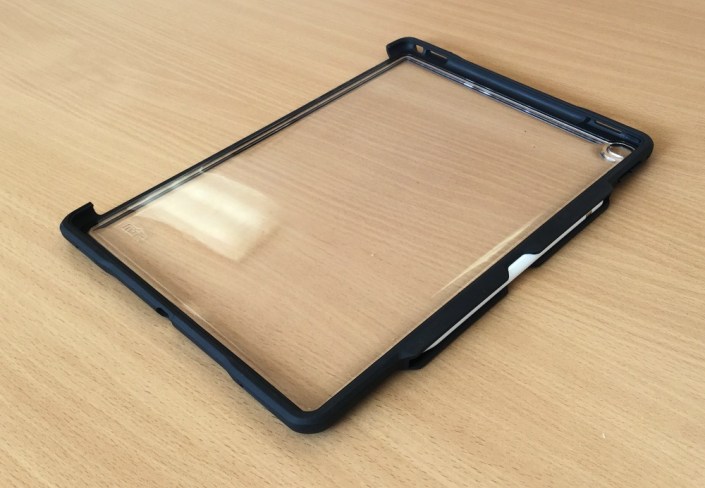
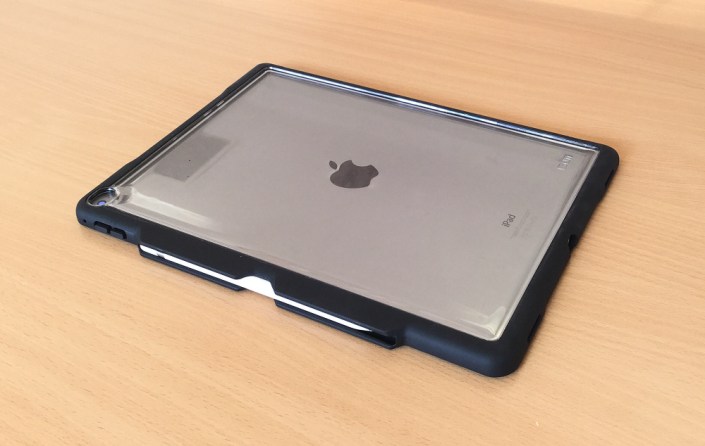
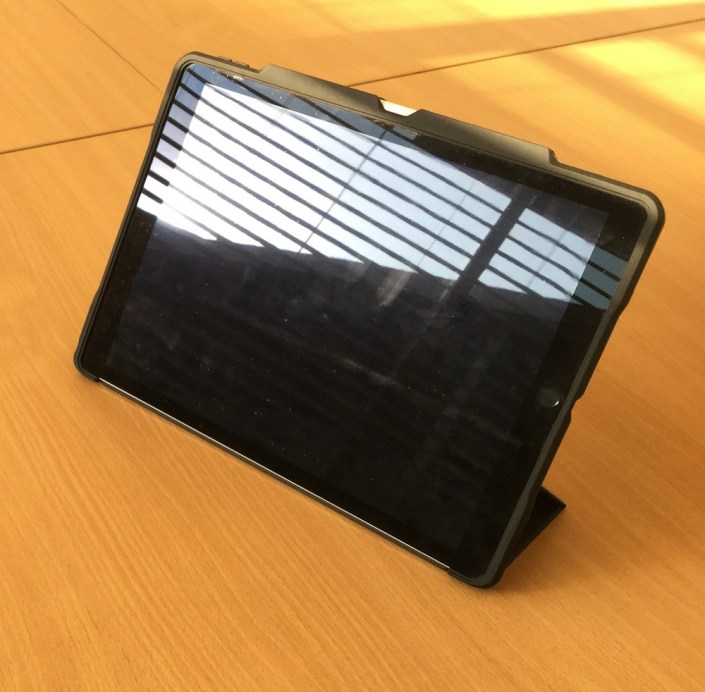
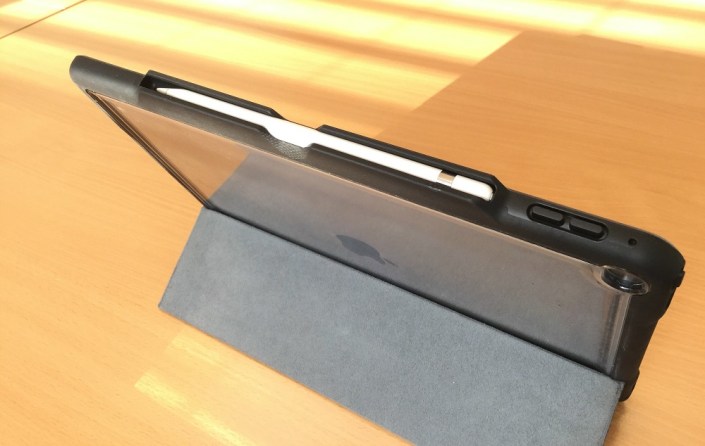
That’s why I was really delighted to unwrap the STM iPad Pro dux case. STM very kindly sent me one to see whether it would fit my purposes on a day-to-day basis. The dux is a sturdy shell that covers the back of the iPad Pro so that you can use the Smart Keyboard or Smart Cover if you prefer (as you can see in the images, I do the latter).

img_4666

The rim of the case is a flexible black plastic that snugly houses the iPad, while the backing is a thick, clear and rigid plastic that offers strong protection and allows the branding of the iPad to show through (which is a nice touch). It does add a reasonable amount of thickness to the iPad, which I wish it didn’t, but there’s a good reason for it which I’ll get onto later.

img_4670

The whole case feels solid and keeps the iPad safe from falls and other kinds of damage. I’m very pleased with the build quality and the case rim is a nice balance between rigidity and flexibility so that it doesn’t feel like the iPad will fall out at any time but it’s quite easy to remove the case if you want to.

img_4667

The most important feature for me, as I mentioned above, was that there is a convenient location for the Pencil. It is nestled into a special section on the rim, which is why the case is the thickness that it is; it makes the case wide enough along its edge to store the Pencil without adding any more thickness. (Many of the other cases I’ve seen, such as the one from Studio Proper, position the Pencil in such a way that it sits on the face of back of the iPad and therefore makes the entire profile much thicker.) Just like the case overall, the Pencil holder is firm but flexible. You won’t feel as though it will ever accidentally fall out, and in fact I tend to flex the lip of the Pencil holder slightly outward in order to ease the Pencil out.

img_4671

There are other ways to store your Apple Pencil. I’ve seen some very attractive desk holders, and some even charge the Pencil when it’s in the holder. But for someone like me who is constantly leaving my desk (to go to class) and frequently on the move (to visit students or attend meetings), the best option is for a case that can hold the Pencil so it’s always there when I need it. I’ve really enjoyed using the dux case and have more or less gotten used to the extra size it it gives to my device – so I’d happily recommend it to anyone with the iPad Pro who uses the Pencil a lot.

NSW Education Symposium 2016

screen-shot-2016-10-29-at-9-15-31-pmI was incredibly fortunate to receive an invitation to the 2016 NSW Education Symposium, a cross-sector gathering of state leaders in education and industry to discuss – as the conference tagline stated – “future reform directions” for the school system in NSW. It was a pretty incredible group of people, with internationally-renowned speakers and proven educational practitioners sharing the stage. 

As with many others, I was busy on Twitter trying to (a) engage in the conversation and (b) ensure that those who couldn’t be present could get a window into the room. Here are a few of the things I shared, though for a more comprehensive account I definitely recommend Matt Esterman’s full Storify of the #nswedu16 feed.