Last week’s blog post

So, I have a confession to make. I’ve been watching the development of generative AI over the course of the last few months with interest, but haven’t really experimented with it much until quite recently. And that includes… the blog post I published last week. I used ChatGPT to produce it because I was keen to (a) see what it was capable of and (b) see whether something co-produced could generate genuine and thoughtful discussion. (I’ll get to my definition for “co-produce” in a minute.) I now have answers to both those questions, but first, let me tell you the story of how the post came about.

(Oh, by the way – this blog post was not written with the help of any AI. Sorry to interject, but I knew some of you would be wondering. Back to the story.)

Earlier this year I was in a conversation with some preservice teachers. One of them asked me a question and I gave him an answer on the spot, but as I reflected on that conversation later that day, I realised that I had never really articulated a full answer to this particular question up until this day. So I hastily jotted down the outline of the answer I gave, so that I wouldn’t forget the key points, and thought to myself that I might revisit these notes and turn them into something a bit more systematic. Here is that page of notes. Yes, I know it’s messy (I told you it was hasty!):
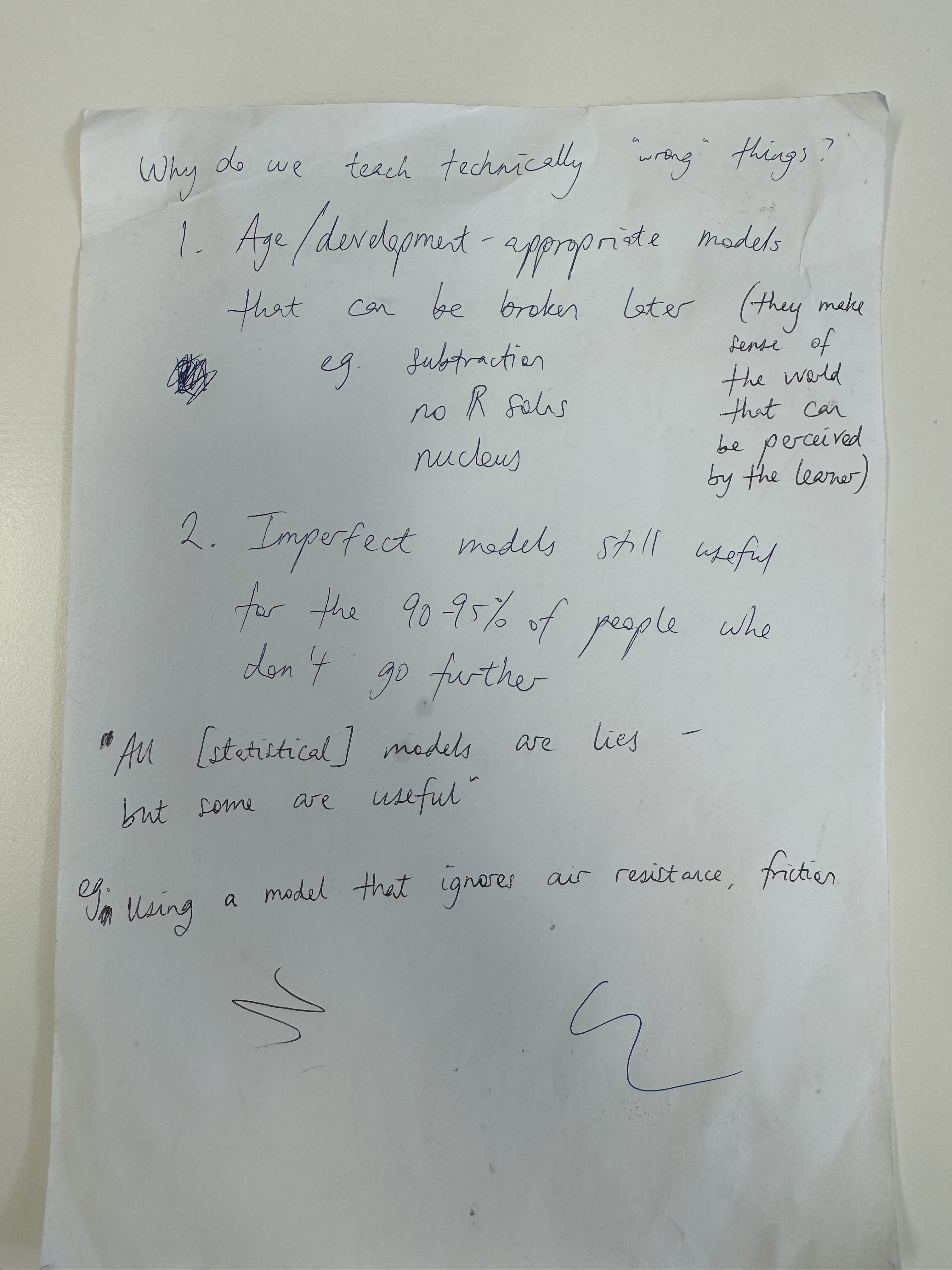
Some time later I read about how OpenAI had updated ChatGPT with some visual recognition models. I wondered, “Could ChatGPT read this and make sense of it? Could it do more than make sense of it – could it expand on the thoughts that I’d written down?” If you read the blog post linked above and make a comparison, you’ll see it did a pretty decent job (and even accurately identified the source of the quote, which I couldn’t remember when I jotted this down).

There’s still much to explore and question, but this small experiment has definitely given me some early answers to the questions I posed before. What is ChatGPT capable of? A coherently written post that successfully expands on my basic ideas, at the very least. That said, I did find its writing style to be quite stilted. In particular, the sentence construction and cadence were remarkably consistent all the way through. It reminded me of this:
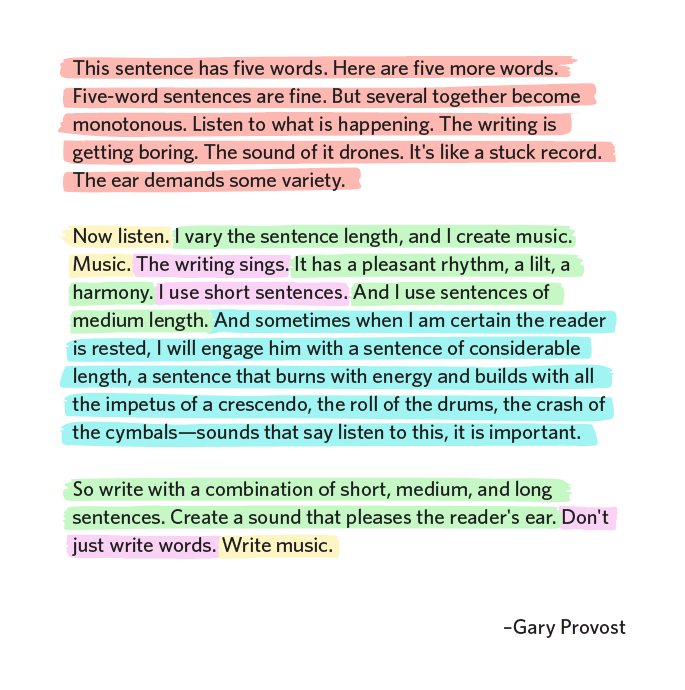
ChatGPT defaults to write more like the first paragraph than the second and third. This plain style is a known phenomenon, and many have written about it. I acknowledge that it can be coached to write in different ways but I did want to see where it naturally landed – and since I imagine that I will use ChatGPT in the future to save myself time, I wanted to see what it was capable of doing without copious amounts of effort from me. I actually enjoy the process of writing and editing, so if I was going to invest significant time into writing something (like this post), then I would rather spend that doing the writing myself rather than wrestling with the LLM to get it to do the work for me. But this is noteworthy nonetheless. And this is where I come to my definition for “co-produce”, which is a phrase I’m adopting because I don’t feel comfortable saying that I wrote the original blog post. (And based on my knowledge of how large language models work, I don’t even know if I would call what ChatGPT does “writing” either!) However, I didn’t ask the AI to brainstorm for me; I provided it a very concrete direction and asked it to expand on what I presented to it. If you’ll permit me to anthropomorphise briefly, we were partners in the process – hence “co-produce”.

My other question was around what kind of discussion this would prompt. Answer: plenty. I’m posting these particular comments because they were posted publicly; I received even more responses in other private contexts where I shared the same post.
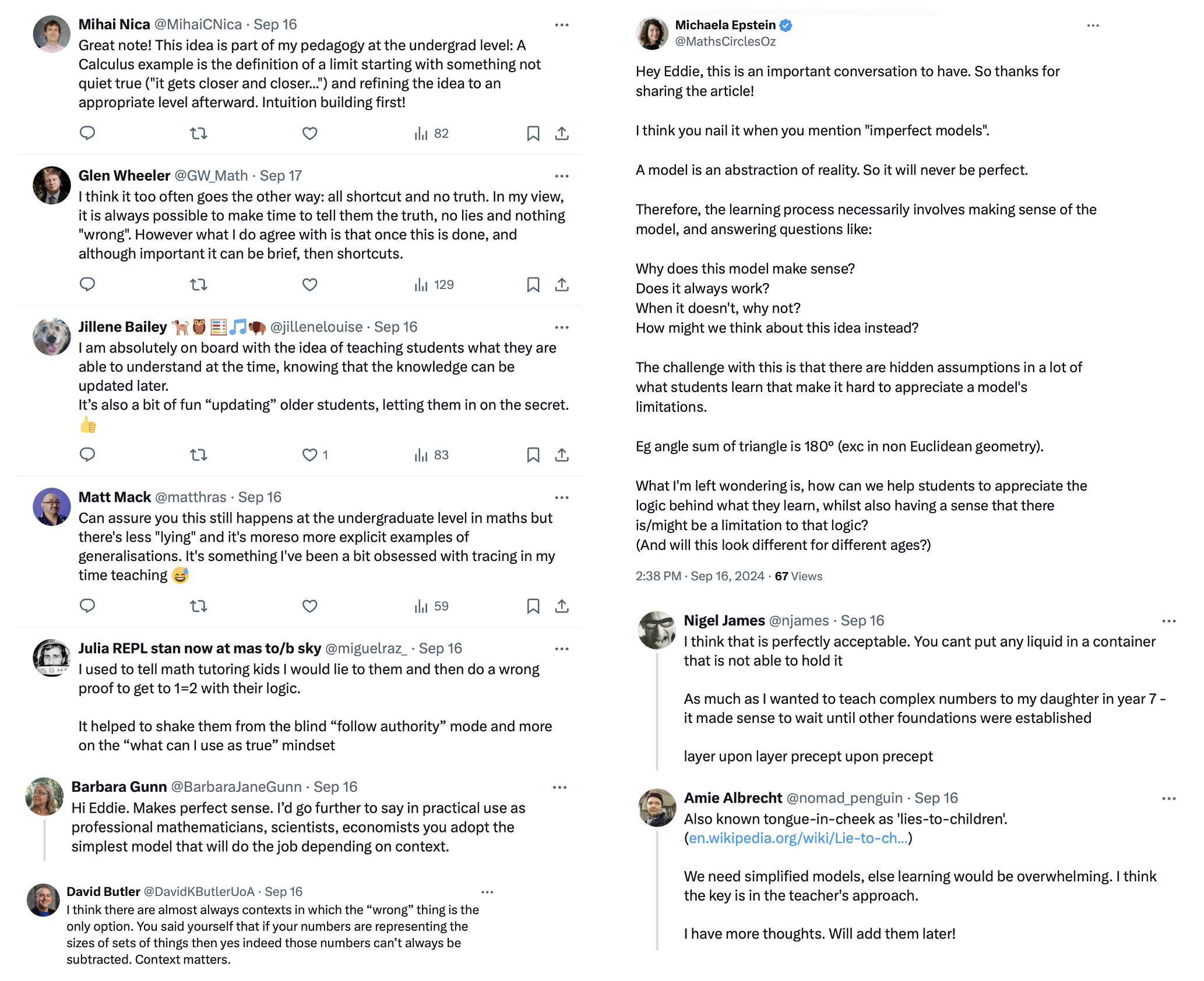
I do wonder if there would have been as much discussion if people had known from the outset that I’d used AI to put this together. Maybe if you were one of the people who responded in the first place, and you’re also reading this reflection of mine, you can throw your thoughts into the ring one more time for me.

Now, just so you know that I don’t think AI is going to replace us any time soon, let me share with you the next chapter of the story. I was at a PL session recently where we were presented with a very classic word problem, the kind that I would instinctively solve by introducing some algebra. But I wanted to try and see if I could explain it to the 9-year-old boy sitting next to me without appealing to algebraic techniques, so I drew this:

I asked ChatGPT, “Can you create accurate diagrams based on an image of hand-drawn text and diagrams?” And with its characteristic confidence, it replied: “Yes, I can help create accurate digital diagrams based on an image of hand-drawn text and diagrams. If you upload the image, I can analyze it and either recreate or enhance the diagrams digitally for clarity and precision. Let me know if you’d like to proceed with that!”

I did want to proceed with that. And here is what ChatGPT handed me:
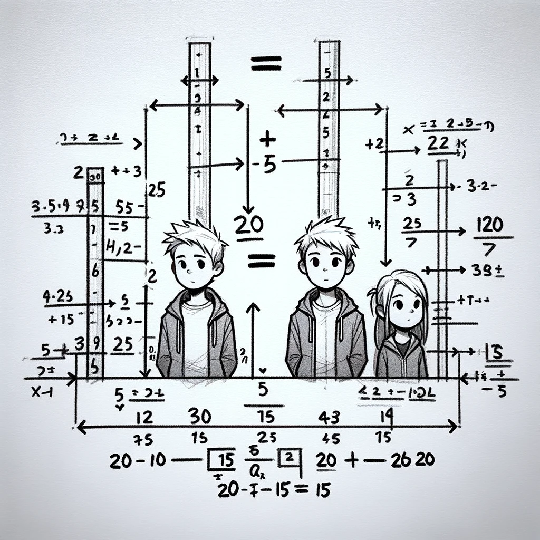
OpenAI still has a ways to go yet! But it seems clear to me that we are still at the very beginning of learning how AI will change what education looks like.

Why Do We Teach Technically “Wrong” Things?

When teaching students, especially in the early stages of their education, it’s common to simplify complex ideas or teach models that are, in some ways, technically “wrong.” (In mathematics, we might say that something isn’t “rigorous”.) This may seem counterintuitive at first—after all, shouldn’t we strive to teach the “truth” from the start? However, I think there are compelling reasons why educators rely on imperfect models and simplified concepts in their teaching.

models that are fit for purpose

One key reason is the need for developmentally appropriate models. These simplified versions of complex concepts are easier for students to grasp, especially when they are still developing their cognitive skills. While these models may not be entirely accurate, they provide a foundation that can be revised (or “broken”) later as the student advances and is ready to tackle more nuanced understandings of the world.

Examples of Simplified Models:

  • Subtraction: for younger students, subtraction is about “taking away” – we start with a number of concrete objects and then we remove some of them, then ask students how many remain. It’s a bit nonsensical in that context to talk about removing 5 objects when you only have 3 to begin with, so subtraction is initially taught without introducing negative numbers. The idea that you “can’t subtract a larger number from a smaller one” is later revised when students learn about negative numbers and broader number systems.
  • The Atomic Nucleus: in science, the atom is often depicted as a simple nucleus with electrons orbiting it, much like planets around the sun. This model is later revised to incorporate quantum mechanics and the probabilistic nature of each electron’s behaviour.

These models may be technically incorrect, but they serve as an essential bridge to more accurate scientific and mathematical understanding. As students mature, they can refine and update their mental models to accommodate more sophisticated ideas.

Imperfect Models Are Still Useful

For the vast majority of learners—those who won’t specialise in advanced scientific or mathematical fields—these simplified models may be all they need to navigate everyday life. I feel as though 90-95% of students won’t pursue careers that require a deep understanding of these subjects, so teaching them perfectly accurate models from the start may not always be practical.

The quote from George Box, “All models are wrong, but some are useful,” encapsulates this idea well. Box was highlighting that even though models are simplifications of reality, they can still provide valuable insights and serve practical purposes. For most people, an imperfect model offers enough accuracy and intuition to make sense of the world and solve everyday problems. Here are some well-known examples of imperfect but nonetheless useful models:

  • Newtonian Physics: High school students often learn about the laws of motion and gravity using Newton’s equations. While these are technically inaccurate at relativistic speeds or quantum scales, they work fine for most real-world applications, such as predicting the motion of everyday objects.
  • Resistive Fluids: In many physics problems, students are asked to ignore air resistance or friction when calculating motion. For instance, when calculating the trajectory of a projectile, the effect of air resistance is often omitted, even though it’s crucial in real-world scenarios like baseball or car racing.
  • Ideal Gas Law: The equation PV = nRT is a simplified model of how gases behave. It ignores interactions between gas molecules, but it provides a useful approximation for most common situations, like understanding the behaviour of air in a balloon.
  • Linear Equations in Economics: In economics, linear models are used to predict relationships between variables, even though real-world systems are often far more complex. These models are useful for basic predictions and decision-making but don’t capture the full complexity of economic interactions.

By ignoring complicating factors, students can focus on mastering the basic principles (very helpful from a cognitive load theory point of view). As their understanding deepens, they can gradually reintroduce these elements to form a more complete picture of the phenomena being studied.


Conclusion: The Role of Simplified Models in Education

While teaching “imperfect” models might seem counterproductive at first, these simplified frameworks play a crucial role in education. They provide an initial foundation on which students can build a more accurate understanding of the world. For most people, these models are useful and practical, enabling them to make sense of the world in an accessible and manageable way.

As students grow and learn, these simplified models are revisited, challenged, and refined, just as scientific theories themselves evolve. In the end, these early approximations help make complex ideas approachable while still providing enough accuracy to be useful for most practical applications.

5 Principles for Making Maths Inspiring

Today I’m giving a presentation titled 5 Principles for Making Maths Inspiring: Strategies for Increasing Student Engagement. Here are some links I refer to during my session:

  1. Ben Orlin – “Practice Math Like a Baby”
  2. Dan Meyer – “Maths needs more WTF”
  3. I Notice / I Wonder: Introduction, Examples)
  4. Exploring Mathematics (stage 5 semester course program)
  5. Index Noughts & Crosses
  6. Odds & Evens
  7. The Story of Integration
  8. Duels & Secrets: Cubic equations and complex numbers
  9. Wootube
  10. Twitter hashtags to follow: #math, #mathchat, #MTBoS
  11. A Brief History of Mathematics
  12. Radiolab

Term 3 Summary

hourglassWe are halfway through the Exploring Mathematics course – and I hope you’ve enjoyed learning some really interesting and unusual mathematical ideas! This seemed like a good time to make sure everyone is on the same page with the current assessments that you’re all working on.

AT1: Class Discussion
At this stage in the course, you have (including today’s lesson, listed below) TEN posts that you should have written in response to concepts and work done during our lessons. Here they are for those who can’t remember:

  1. Introductory lesson
  2. The Golden Ratio
  3. 3 videos (Beauty & Mathematics)
  4. Fractals
  5. Artwork ideas
  6. Set Theory topic review
  7. Discovery or invention?
  8. Comparing the sizes of sets (rational vs. natural numbers)
  9. Division by zero (What is 0 divided by 0? How about 0 to the power of 0?)
  10. Video ideas (today’s lesson)

Please check back through all the posts and make sure you are up-to-date. Don’t forget to participate in the dialogue too by actively discussing and questioning the ideas posted by others.

AT4: Video Composition
You have already formed your groups for this, and you’ve already been issued the assessment outline. Today your task is to identify three potential ideas to make your video about and then create storyboards for each. You must then write individually about:

  • The pros and cons of each idea
  • Which idea you like best and why
  • How you (personally – not the whole group) will contribute to the project in the lead-up to submitting Stage 1 (draft)

Happy holidays everyone!